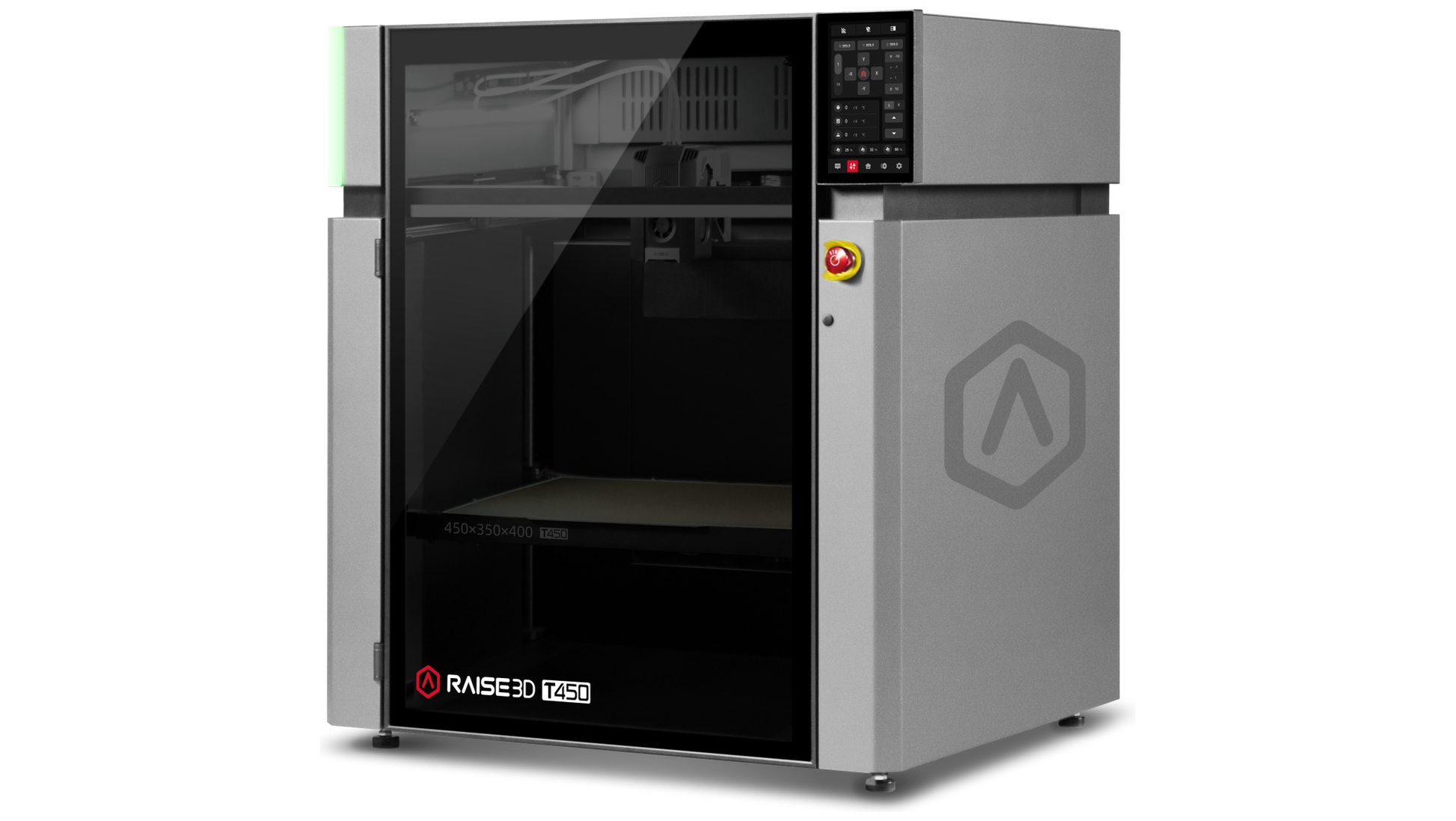
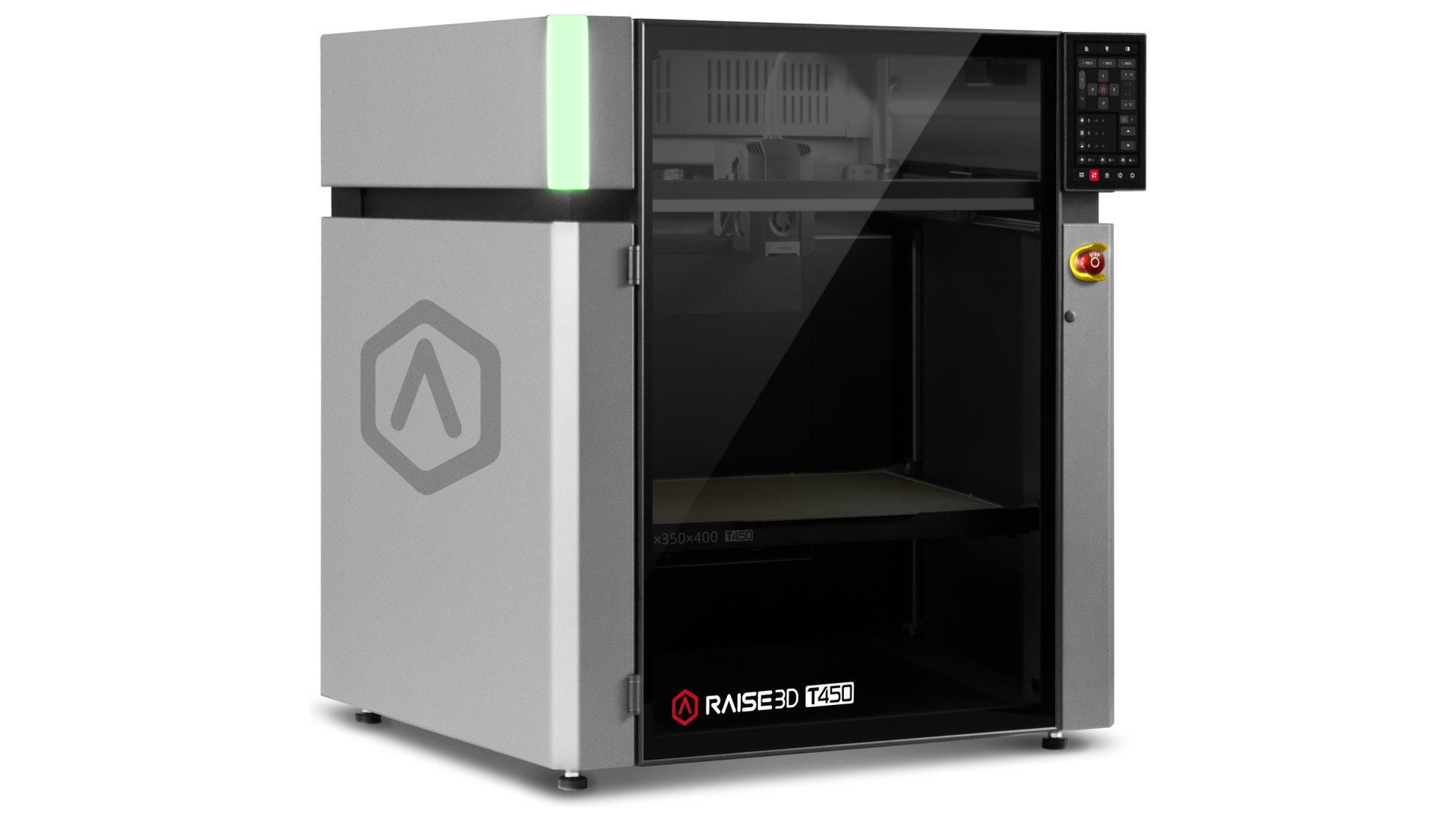

TwinFlow™ Dual Extrusion – Two Printing Modes
The TwinFlow™ system uses two separate 1.75 mm filament paths that converge into a single nozzle through a specially designed Y-junction. This enables two different printing modes:
Dual-Material Printing: Two filaments are fed sequentially through the shared nozzle, allowing the use of different materials or colours within the same print. Depending on material compatibility and settings, this also supports compatible support-material workflows. Since both filaments use the same nozzle, there is no need for XY offset calibration between separate print heads, and the risk of mechanical collisions between nozzles is eliminated. Material compatibility, temperature requirements and purging must still be considered.
High-Capacity Material Supply for Long Prints
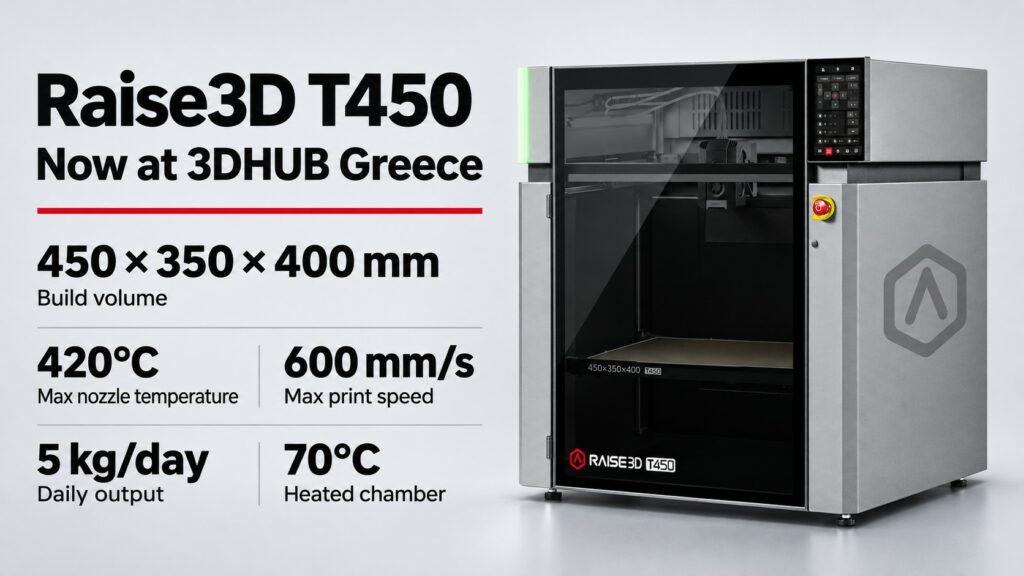
Long production runs require sufficient material supply. The T450 supports two 2.5 kg filament spools, providing up to 5 kg of material in total. Combined with the remote auxiliary feeding system, the printer can process up to 5 kg of material within 21 hours under validated test conditions. This reduces the need for manual spool changes during extended print jobs. When planning a print, material consumption for the part, support structures and purging should also be taken into account.
4MD CoreXY Motion System
The 4MD CoreXY motion system is designed to maintain stability and reduce mechanical resonance during high-speed printing. It supports toolhead travel speeds of up to 1,500 mm/s and accelerations of up to 30,000 mm/s². These are maximum motion-system capabilities rather than actual printing speeds. The system helps reduce corner bulging and uneven material deposition, while the single-nozzle design eliminates alignment differences between separate print heads. The T450 is specified to achieve IT11-grade dimensional precision under defined conditions.
420 °C Hotend with Wear-Resistant Nozzle
The T450 hotend supports nozzle temperatures of up to 420 °C and is designed for engineering plastics and abrasive fibre-reinforced materials. The nozzle combines a high-conductivity chromium-zirconium-copper (CuCrZr) base with a solid silicon carbide (SiC) tip. This construction provides efficient heat transfer and improved wear resistance when printing demanding materials. A 0.4 mm nozzle is included as standard. The high-temperature configuration also provides a basis for evaluating selected small PEEK components under tightly controlled process conditions. Such applications must be validated with Raise3D before purchase.
Air Flow Manager 2 – Active Chamber Heating
The Air Flow Manager 2 actively heats the build chamber to help maintain stable temperatures when printing large and temperature-sensitive parts. The chamber can reach up to 70 °C, while the heated silicone build plate supports temperatures of up to 120 °C. This controlled thermal environment helps reduce warping and layer separation, particularly when printing large ABS components. A four-screw Z-axis provides additional support for heavy builds, while integrated HEPA and activated carbon filters help capture airborne particles and fumes.
Automated Monitoring for Extended Print Jobs
The T450 combines sensors, cameras and onboard computing to help monitor print progress and machine conditions. With computing power of up to 1 TOPS, its monitoring system can detect selected issues, including spaghetti failures and filament runout, and alert the operator or pause the print when intervention is needed. Two onboard cameras provide additional visibility: a 1080p chamber camera for remote monitoring and a 2592 x 1944 nozzle camera for closer inspection of the printed layers.
Large-Format Printing Reduces Production Time
The T450’s 63-litre build volume makes it possible to print larger components in one piece instead of splitting them into several sections. One example is a casting pattern for RBP Metallurgy. When printed on the T450 as a single part, the estimated print time is reduced from 53.9 hours to 17.7 hours compared with printing the same design in four parts on the Pro3 HS – a reduction of 67.16%, before assembly. The comparison also shows 37.88% less deposited material, from 1,666 cm³ to 1,035 cm³, and a 96.09% increase in average extrusion speed, from 128 mm/s to 251 mm/s. Printing in one piece also removes the need to align, bond and finish joints between separate sections.
Industrial Applications and Proven Results
The T450 is suitable for a range of industrial applications, including casting patterns, production tooling, fixtures and custom factory equipment. One example is CATL, a leading battery manufacturer that used Raise3D technology to produce cell transport pallets. The solution reduced production lead time from 40 to 10 days (75%) and pallet weight from 8 kg to 2 kg (75%). Other applications include robotic bomb-disposal chassis for the Florida Police Department, ergonomic assembly fixtures for Australia Open Wiring Systems and custom paediatric scoliosis braces developed by the Medical 3D Printing Innovation Center.
Software and Open Material Architecture
The T450 integrates with Raise3D’s ideaMaker slicing software and features a 7-inch touchscreen with a Debian-based motion control architecture. It supports Raise3D’s Hyper Speed and Industrial material portfolios, including PPA CF, PPS CF and PET Support. Through the Raise3D Open Material Program (OMP), users can also work with approved third-party filaments using validated, pre-configured slicing profiles. This provides greater flexibility when selecting materials for different production requirements.