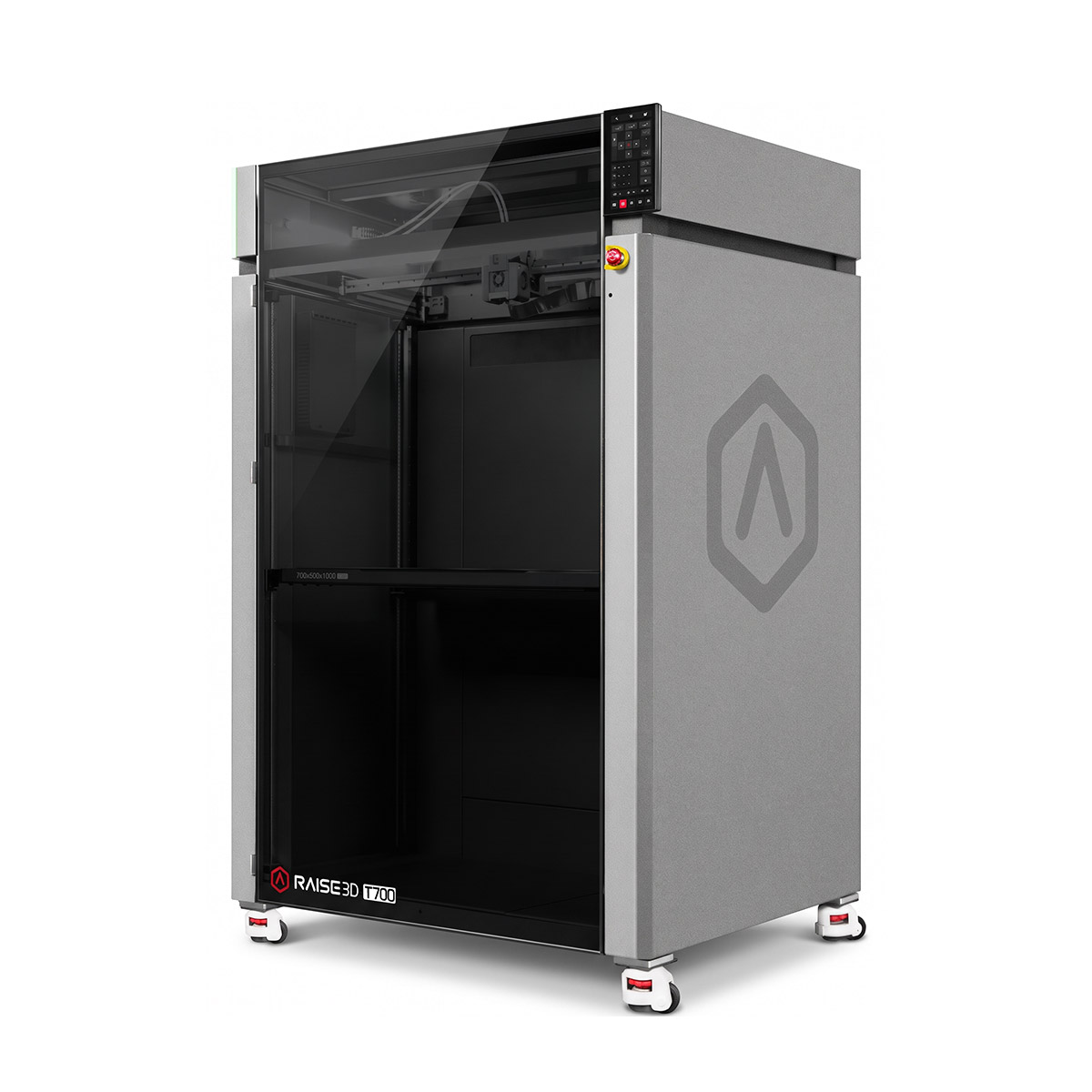
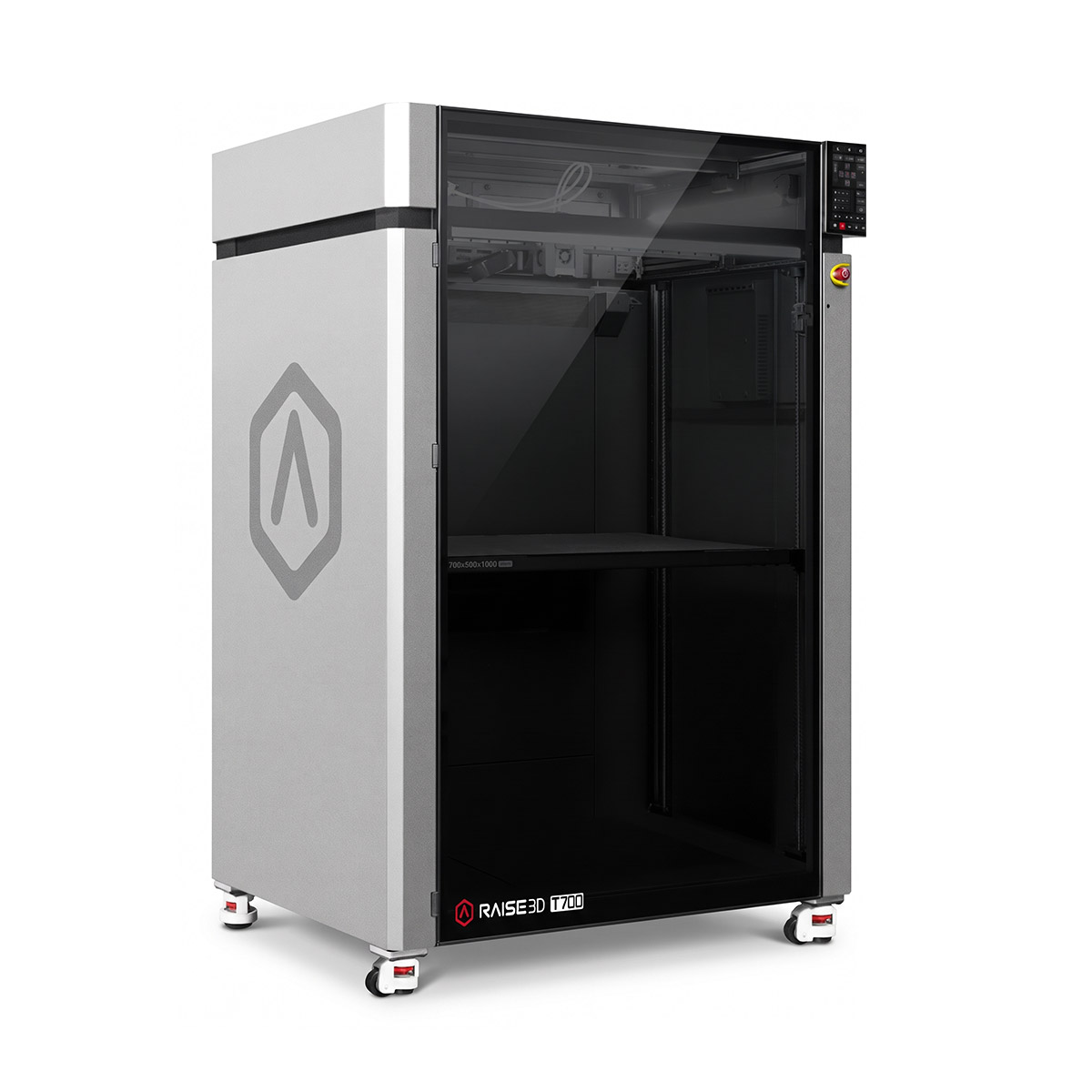

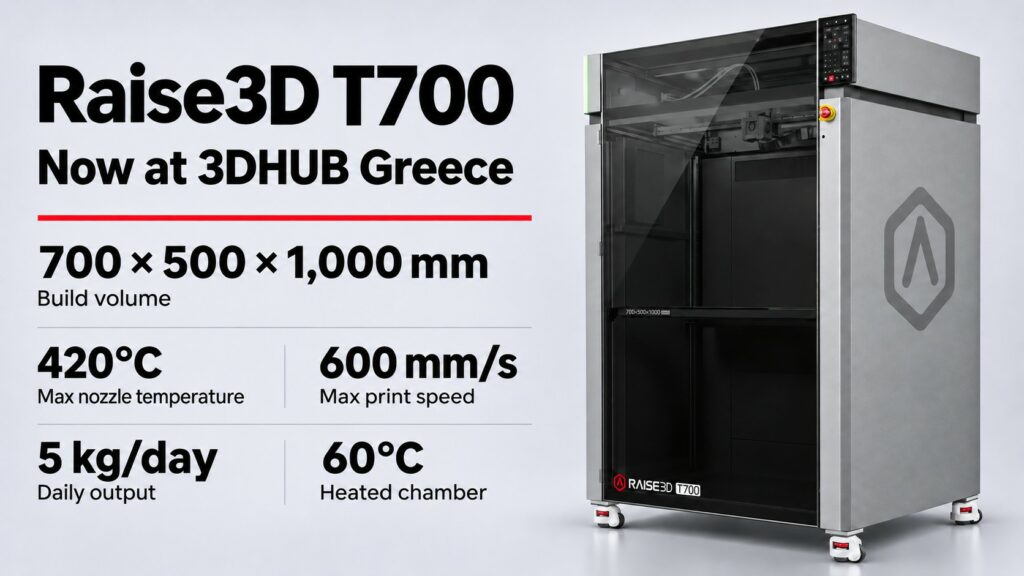
The Raise3D T700 is designed for large-scale industrial manufacturing, enabling reliable on-demand production without the need for custom tooling. Built around an aerospace-grade aluminum frame and featuring an expansive 350-liter build volume, the T700 supports continuous, round-the-clock production of full-scale prototypes, large tooling, casting patterns, and end-use components. Its combination of high material throughput, advanced extrusion technology, and precise motion control makes it suitable for demanding industrial applications.
350-Liter Build Volume for Large Single-Piece Components
With a build volume of 700 x 500 x 1,000 mm, the T700 can produce large and complex components as single-piece objects. Printing parts in one piece eliminates the need to divide models into multiple sections, align joints, or assemble separate components. This reduces post-processing work and helps shorten production lead times.
The large build area is well suited to manufacturing automotive prototypes, transport pallets, industrial ducting, large tooling, casting patterns, and artistic sculptures. Producing components as single pieces can also reduce the need for bonded joints and provide greater structural continuity.
TwinFlow™ Extrusion – High Flow and Dual-Material Printing
The TwinFlow™ extrusion system routes two separate filament paths into a shared single nozzle through a precision Y-junction manifold. This design eliminates the need for mechanical XY offset calibration between separate printheads and supports two operating modes to meet different production requirements.
- High-Flow Printing (Simultaneous Feeding): Two spools of the same material are fed simultaneously through the shared nozzle to increase the melt rate and material throughput. The system delivers a volumetric flow rate of up to 80 mm³/s, tested with Hyper Speed ABS V2 at 250 °C, helping reduce print times for geometries limited by extrusion flow.
- Dual-Material Printing (Sequential Feeding): Two different filament paths are fed sequentially through the nozzle to produce multi-material parts, dual-color prints, and compatible breakaway or soluble support structures without the alignment issues associated with separate toolheads.
High-Temperature Hotend with CuCrZr and Solid SiC Tip
Designed for efficient heat transfer and high wear resistance, the T700 hotend operates at temperatures of up to 420 °C. The nozzle combines a high-thermal-conductivity chromium-zirconium-copper (CuCrZr) body with a solid silicon carbide (SiC) wear-resistant tip. This construction supports the processing of abrasive engineering materials, including carbon-fiber and glass-fiber reinforced composites such as PPA CF and PPS CF, while helping reduce nozzle wear.
The T700 comes standard with a 0.6 mm nozzle, with a 0.4 mm option also available. The larger standard nozzle supports higher material throughput, making it particularly suitable for large-format printing and demanding composite materials.
Air Flow Manager 2 – Active Chamber Heating for Large Parts
Maintaining stable temperatures is essential when printing large technical components, particularly with materials such as ABS that are sensitive to temperature fluctuations. The T700 features Air Flow Manager 2, combining active chamber heating, an electric top cover, and an auxiliary heat dissipation module to manage the thermal environment inside the printer.
Active chamber heating reaches temperatures of up to 60 °C, helping minimize temperature differences as parts cool and reducing the risk of warping and layer separation. The system is designed to support consistent printing conditions, particularly when producing large engineering components.
The heated build plate, featuring a silicone heater pad and temperatures of up to 120 °C, supports reliable bed adhesion. A rigid four-screw Z-axis system provides stable mechanical support throughout the printing process, including when producing tall and heavy components.
Extended Material Supply for Continuous Printing
Large-format production often involves extended print jobs and significant material consumption. The T700 accommodates two 2.5 kg filament spools, providing a total material capacity of up to 5 kg directly to the extrusion system.
This expanded material supply reduces the need for manual spool changes and helps minimize machine downtime during long production runs. It is particularly useful when printing large components that require substantial amounts of material or when running jobs over extended periods.
Process Monitoring and AI Defect Detection
To help protect long and material-intensive production runs, the T700 is equipped with more than 20 integrated sensors and a dual-camera system. This includes a 1080p live chamber camera and a 5 MP nozzle inspection camera (2592 x 1944), providing visibility into both the overall printing process and the nozzle area.
Powered by 1 TOPS of onboard computing performance, the monitoring system tracks print progress, filament supply, and machine conditions. AI-based defect detection identifies issues such as spaghetti failures, nozzle clumping, and filament runout. When problems are detected, the system can alert operators or automatically pause the print to help prevent material waste and protect the production process.
4MD CoreXY Motion System and Software Integration
The T700 uses a 4MD CoreXY motion architecture designed to combine high-speed movement with precise motion control across its large build area. The system supports travel speeds of up to 1,500 mm/s and accelerations of up to 30,000 mm/s², achieving printing speeds of up to 600 mm/s while maintaining IT11-grade dimensional precision.
Operation is managed through an intuitive 7-inch touchscreen running embedded Debian Linux. The T700 integrates with ideaMaker slicing software, providing tools for preparing and managing print jobs. It supports both Raise3D filaments and third-party materials through the Raise3D Open Material Program (OMP), offering flexibility when selecting materials for different industrial applications.